If you’re living in the US as an Australian, you can support the charities you care about. But the rules around expat charitable donations, tax breaks, and what counts as volunteering on a work visa are trickier than most people think. I think about this a lot. Partly that’s because I’m President of Variety – the Children’s Charity of New York. And partly because the question lands in my inbox almost every month. Here’s how it actually works in 2026.
Can expats make charitable donations in the US?
Short answer: yes. Nothing in US tax law or visa law stops a foreign national from giving to a charity. That applies whether you’re on an E-3, H-1B, green card, or any other status. You can give to a local nonprofit, a national relief fund, or your kid’s school. The mechanics are no different from what a US citizen does. Write a check, set up a monthly gift, drop cash in a bucket, or click “donate” online.
Where it gets tricky is the tax side. The other piece is what counts as volunteering, and what counts as working without a permit. Both have their own rules, and getting them wrong has real costs.
Are expat charitable donations tax-deductible?
Sometimes. The answer depends on where the charity sits, where you file taxes, and whether a tax treaty links the two.
The 501(c)(3) rule for expat charitable donations
Under US tax law, you can only deduct charitable gifts on your US tax return if they go to a 501(c)(3). That status comes from a part of the Internal Revenue Code. Schools, hospitals, religious groups, arts groups, and most national charities you’ve heard of qualify.

If you itemize your federal return (rather than take the standard deduction), gifts to a 501(c)(3) lower your taxable income. However, for most expats on a typical salary, the standard deduction is bigger than what they would itemize. So the tax break only kicks in once your yearly giving gets significant. Or once you have other itemizable costs like mortgage interest or state taxes.
This is one of those areas where general guidance only gets you so far. Talking to someone who actually gets cross-border tax is worth doing if you plan to give in a meaningful way each year. I send people to Apt Wealth Partners for that kind of planning.
Australia–US tax treaty and expat charitable donations
Here’s the part most Aussie expats don’t know: the Australia–US tax treaty does not include a two-way charity deduction. A gift from the US directly to an Aussie-listed charity generally won’t earn a US tax break. The same rule runs both ways. Send money from Australia to a US charity, and Australia generally won’t honor the deduction either.
The US treaty network does have a few exceptions for cross-border charity gifts. Canada, Mexico, and Israel each have a specific carve-out in their treaties. Australia, though, is not one of them. Suppose you’ve moved here and want to keep backing your old high school’s foundation in Adelaide. The US treats that as a personal gift — not deductible.
Donating to Australian charities as an expat
There are work-arounds. The most common one is to give through a US-listed “Friends of” group. Another route is a fiscal sponsor that holds 501(c)(3) status and can grant funds to overseas charities under IRS rules. For example, the American Australian Association runs scholarship and cultural programs that earn US tax breaks. CAF America (Charities Aid Foundation) runs a donor-advised fund model. It can grant to qualifying foreign charities once they pass an equivalency check.
Whether any of this makes sense for you depends on the size of your giving and your appetite for paperwork. Below a few thousand dollars a year, the friction isn’t worth it. Above that, it’s worth a chat with a cross-border advisor before you write the check.
How to find a US charity to support
If you’re new to giving in the US and don’t have a cause in mind, three resources help:
- Charity Navigator — free, independent ratings on financial health, accountability, and transparency.
- GuideStar / Candid — IRS Form 990 data on every listed 501(c)(3). You can see how much a charity spends on programs versus overhead.
- The BBB Wise Giving Alliance — accreditation for charities that meet 20 separate criteria.
Beyond the watchdogs, the best move is direct contact. Reach out to the charity. Ask about their programs and what your money funds. Good charities answer those questions without delay.
Volunteering as an expat in the US
Volunteering is a separate question. The rules here come from visa law, not tax law. You can volunteer in the US as a foreign national. The catch: the work has to stay truly unpaid, and it can’t fill a paid role. That line matters. The split between “volunteering” and “unauthorized work” is where people get into visa trouble.
Volunteering rules on an E-3 or H-1B
If you’re on a work visa like the E-3 or H-1B, your work permit belongs to the employer who sponsors you. You can usually volunteer outside that role. Common examples include serving meals at a soup kitchen, helping at a school fundraiser, or sitting on a nonprofit board. However, the work has to stay truly unpaid and not replace what a paid worker would do. I’ve written more about this in Can I volunteer on an E-3 Visa?. The same rules broadly apply to most work visas.
The risky zone is volunteering at a for-profit, or doing pro work for a nonprofit that would normally pay someone. Suppose a marketing agency offers you a “volunteer” role to build their client website for free. That’s not volunteering — that’s unauthorized work. When in doubt, talk to a visa lawyer before you say yes.
Charities I support personally
If you’re looking for somewhere to start, here are two groups I’m involved with.
Variety – the Children’s Charity of New York — I serve as President of the board. Variety supports sick, disadvantaged, and underprivileged children across the tri-state area through scholarships, adaptive equipment, and direct grants to families. It’s one of the oldest children’s charities in the US. The New York chapter has run since 1934.
Gifts qualify for a US tax break if you itemize.
A note on political donations from expats
Political giving works very differently from charity giving, and the rules are much stricter. Foreign nationals cannot give to political campaigns in the US. That rule covers federal, state, and local races, and it includes candidates and party committees. The penalties for breaking it are serious. I’ve covered this in detail in Political Donation Rules for Foreign Nationals & Non-Citizens.
If you want to back a cause politically without breaking the rules, you have a few options. Issue-based 501(c)(4) groups exist, and they work differently from direct campaign gifts. Even there, the line is worth checking with a lawyer.
Yes. Charitable giving has nothing to do with visa status. Anyone living in the US can give to a registered charity. Whether you can claim a tax deduction is a separate question that depends on whether you file a US tax return.
Generally no. The Australia–US tax treaty does not include a reciprocal charity deduction, so a direct gift to an Australian-registered charity is not deductible on a US return. You can sometimes give through a US-registered “Friends of” group or a donor-advised fund that grants overseas to get the deduction.
501(c)(3) is the IRS designation for US-registered tax-exempt charitable organizations. Only gifts to these organizations are tax-deductible on a US federal return. The rule applies the same way to expats and US citizens who itemize their deductions.
Usually yes, as long as the work is genuinely unpaid and would not normally be a paid role. Volunteering at a food bank, helping at a charity event, or sitting on a nonprofit board generally falls within the allowed range. Doing professional work for free at a business that would otherwise pay for it is the gray area to avoid.
No. The IRS does not allow a tax deduction for the value of volunteer time or services. You can deduct unreimbursed out-of-pocket expenses you incur while volunteering for a 501(c)(3), such as mileage or supplies you bought.
No. Political donations to candidates, parties, or PACs fall under federal election law and are prohibited for foreign nationals. Charitable donations to 501(c)(3) organizations fall under tax law and are allowed regardless of citizenship.
Yes. Corporate matching programs apply to employees regardless of visa status. The match goes to the same 501(c)(3) you donated to, and your own portion is deductible if you itemize.
No expat-specific form is required. You claim charitable deductions on Schedule A of Form 1040 (or 1040-NR if you are a nonresident alien for tax purposes), the same way US citizens do. Keep receipts for any donation. IRS rules require a written acknowledgment from the charity for any single donation of $250 or more.
Disclaimer: I’m not a tax lawyer, accountant, or visa lawyer. This article reflects general info available in 2026 and isn’t personal advice. Tax law and visa rules change. Check with a qualified professional before you make a call on charity giving, deductions, or volunteering on a visa.
You might also like
 Related to: E-3 Visa VolunteeringCan I volunteer on an E-3 Visa?
 Related to: Expat Tax Planning7 Australian Financial Strategies That Can Backfire If You’re Living in the US
 Related to: Expat Tax PlanningExpert Q&A: Managing Your Australian Assets While Living in the US
 Related to: Political Donations Foreign NationalsPolitical Donation Rules for Foreign Nationals & Non-Citizens 2026
 Related to: Expat Tax FilingUS Taxes and Expat You: Learning to Love Tax Time 2025 (Webinar Recording)
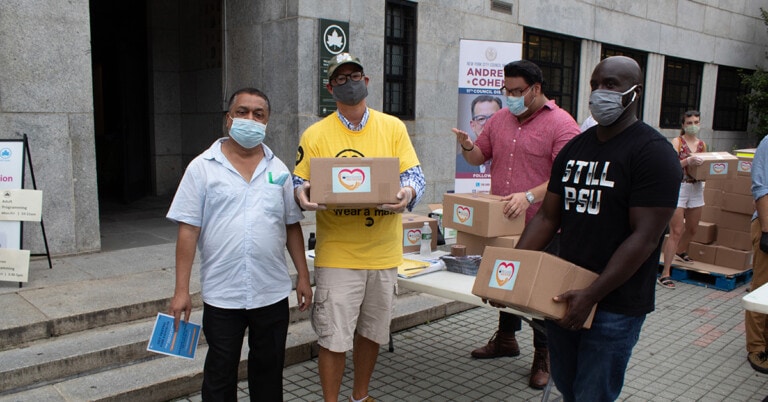 Related to: Volunteer OpportunitiesHow to volunteer in New York City 2026