











My wife Stacey and I had Danny in November 2023, then Liam in December 2025 — both born in New York. Having a baby in America is profoundly different from doing it in Australia. Medical system, insurance reality, costs, paperwork tail — almost none of it works the way you’d expect. Here’s the 2026 guide I wish someone had handed me before our first.
Why having a baby in America is wildly different from Australia
If you’ve ever had a baby in Australia, you have a mental model of how this works. However, almost none of it transfers. You see a GP. You get referred to a hospital antenatal clinic. The cost is mostly absorbed by Medicare. Your hospital is whichever public one services your area. Then the bill at the end is small or zero.
None of that applies in the US. Here’s what changes:
- There is no Medicare-equivalent for visitors or visa holders. Your Australian Medicare doesn’t cover you here at all. The US is not on the reciprocal agreement list.
- Insurance is the only safety net. Without it, you pay full price for everything — and “full price” for a US hospital birth runs $30,000-$50,000 for a vaginal delivery and $50,000+ for a Cesarean.
- You choose your provider. No GP referral system. You pick an OB/GYN, you pick the hospital, and you arrange the relationship yourself.
- The paperwork doesn’t end at discharge. Birth certificate, Social Security number, and — for Australians — citizenship by descent and passport applications stretch the admin tail to 6-12 months.
For more on how US healthcare works generally as an expat, my full healthcare hub is here.
The first decision: which insurance covers having a baby in America?
This is the most important decision you’ll make. Specifically, get it wrong and a routine birth costs you $50,000. Get it right and you’ll likely pay $1,500-$5,000 out-of-pocket on a good plan.


Practically, you have three main paths:
Employer-sponsored health insurance
If either parent has an employer plan, this is almost always the cheapest path. Most US employer plans cover prenatal care, delivery, and the immediate newborn stay as part of standard benefits. Check the maternity coverage details before assuming. What to confirm:
- Is the hospital you want in-network?
- Is your OB/GYN in-network?
- What’s the out-of-pocket maximum? (This is what you’ll actually pay in a worst case.)
- Does the newborn get added to your plan automatically, or do you need to enroll them within 30 days?
- Is NICU covered if needed? (Watch for out-of-network anesthesiologists or specialists billing separately.)
ACA marketplace plans
If you don’t have employer coverage, you can also buy directly from HealthCare.gov during open enrollment. Alternatively, you can enroll after a qualifying life event (moving to the US counts; pregnancy alone does NOT in most states). Coverage levels and costs vary by state. Most plans cover maternity as a required “essential health benefit.”
International expat insurance (Cigna Global, ICI)
International plans like Cigna Global or quotes via International Citizens Insurance cover maternity, but with a critical timing rule. Most international plans have a 10-12 month maternity waiting period from policy start before maternity benefits kick in. If you’re planning a family and need international coverage, sign up well before you start trying.
If you’re shopping around, my comparison of international plan trade-offs is the next read.
Finding a prenatal care provider (OB/GYN vs midwife)
In the US, however, the default prenatal care provider is an OB/GYN — an obstetrician/gynecologist. They handle both routine prenatal care and the actual delivery, unlike the Australian system where you might see a different obstetrician at the hospital from the one who saw you during pregnancy.
Midwife-led care exists in the US but is less common than in Australia. You’ll find midwives at:
- Birth centers (free-standing facilities, not hospitals)
- Some hospital midwife practices
- Home birth midwives (legal status varies by state)
To find an OB/GYN:
- Open your insurance provider’s online directory
- Filter by “in-network OB/GYN” near your ZIP code
- Check the hospital where they have admitting privileges — that’s where you’ll deliver
- Call to confirm they’re accepting new pregnant patients
- Ideally book your first appointment around 8-10 weeks
If you don’t already have a primary care doctor in the US, getting one before pregnancy is also worth doing — they coordinate care that the OB/GYN won’t.
What prenatal care actually costs (and what insurance pays)
A typical pregnancy in the US involves:
- 10-15 prenatal visits (every 4 weeks early, then 2 weeks, then weekly toward the end)
- An early dating ultrasound (8-10 weeks)
- An anatomy ultrasound (20 weeks)
- Glucose tolerance test (24-28 weeks)
- Group B strep test (35-37 weeks)
- Extra monitoring if your pregnancy is classified as high-risk
Without insurance, prenatal care alone can run $2,000-$5,000 before you even reach the delivery before you even reach the delivery. With insurance, you’ll typically pay co-pays per visit ($20-$60 each) and may hit your deductible during the routine testing. The pattern: insured pregnancies see most of the bill absorbed; uninsured pregnancies are a slow accumulating disaster.
Two practical notes:
- First, bills arrive months after appointments. Don’t assume you’ve paid for something just because no bill has come yet.
- Track every Explanation of Benefits (EOB) statement. Errors on insurance claims for maternity care are common, and once you’re past the deadline to dispute, you’re stuck with the charge.
Choosing your hospital for having a baby in America
In Australia, you generally go to whichever hospital services your area. However, in the US, you choose — within the constraints of your insurance network. What to evaluate:
- Is it in-network for your insurance? This is non-negotiable. An out-of-network hospital can turn a $5,000 bill into a $50,000 one.
- Is your OB/GYN’s admitting privileges there? They can only deliver at hospitals where they have privileges.
- What’s the hospital’s NICU level? Levels I-IV. Level III and IV NICUs handle high-risk and very premature babies. If your pregnancy is high-risk, this matters.
- What’s the C-section rate? US hospitals publish this; rates vary widely. High rates can signal a more intervention-heavy approach to delivery.
- What’s the maternity stay like? Standard US discharge is 48 hours for a vaginal birth, 72-96 hours for a Cesarean. Some hospitals have private postpartum rooms; others use shared rooms.
- Distance from home. Labor doesn’t wait for traffic.
Finally, tour hospitals during the second trimester if you can — most run monthly tours.
The birth itself: what to expect when having a baby in America
Specifically, a few things that surprise Australians:
- Labor and delivery (L&D) wards are typically one nurse to one patient during active labor. That’s more attention than most Australian public hospitals.
- Continuous fetal monitoring is the default, not the exception. If you want intermittent monitoring, discuss it with your provider in advance.
- Epidural rates are very high. Around 70% of US births involve an epidural, vs around 30% in Australia. Anesthesia is on call 24/7 at most large hospitals.
- Your OB/GYN doesn’t necessarily deliver. Many practices rotate — whoever is on call when you go into labor handles the delivery. Confirm this with your practice during pregnancy.
- Birth photographers, doulas, and birth plans are common. Most hospitals accept written birth plans, but the actual care decisions are made by the medical team based on what’s happening.
- Postpartum rooms are usually private. You stay in the same room as the baby (“rooming-in”) for the duration of the stay, which is universal in the US.
For example, with our two births, both times, the care was excellent. Both times, the bills took six months to fully resolve.
Cesarean rates and your delivery options
The US C-section rate, however, hovers around 32%. However, different hospitals vary widely — some run as low as 20%, others as high as 45%. Your hospital choice meaningfully shifts your statistical odds.
Specifically, reasons for a planned Cesarean include:
- Breech presentation that doesn’t turn
- Previous C-section (though Vaginal Birth After Cesarean / VBAC is increasingly supported)
- Placenta previa or other placental issues
- Multiple gestation in some cases (though many twins are delivered vaginally)
- Maternal health conditions where labor would be unsafe
If a C-section becomes necessary during labor, your insurance treats it the same as a vaginal birth in terms of network rules — but the cost is higher and the recovery is longer. Most US insurance plans treat both vaginal and Cesarean births as standard, covered events. The out-of-pocket can still run several thousand dollars even with good coverage.
Therefore, talk to your provider during pregnancy about their approach to interventions and when they’d recommend a Cesarean. The conversation is much harder to have in the middle of labor.
The real cost of having a baby in America (insured vs uninsured)
First, the 2026 ballpark numbers, based on national averages:
| Scenario | Total billed | What you actually pay |
|---|---|---|
| Uninsured, vaginal birth | $30,000-$50,000 | The full amount, usually paid in installments to collections |
| Uninsured, Cesarean | $50,000-$80,000 | Same — full price |
| Good employer insurance, vaginal | $30,000-$50,000 billed | $1,500-$5,000 out-of-pocket (deductible + co-insurance) |
| Good employer insurance, Cesarean | $50,000-$80,000 billed | $3,000-$8,000 out-of-pocket |
| ACA marketplace plan, vaginal | $30,000-$50,000 billed | $2,000-$8,000 out-of-pocket (depends on plan tier) |
| International plan, vaginal | $30,000-$50,000 billed | $500-$3,000 out-of-pocket after deductible |
However, costs vary wildly by state, hospital, and complications. The numbers above are starting points, not guarantees. If your baby spends time in the NICU, add $5,000-$50,000+ depending on the length of stay and coverage.
The single biggest cost trap: out-of-network anesthesiologists. Even if your hospital and OB/GYN are in-network, the anesthesiologist who shows up for your epidural may not be. Some states have outlawed “surprise billing” for this, but enforcement varies. Ask in advance — preferably in writing — whether all anticipated providers will be in-network.
For broader context on managing US healthcare costs, my healthcare hub covers the full picture.
After the birth: what happens before you leave the hospital
Then the 48-72 hours between birth and discharge get busy. Expect:
- Routine newborn screening tests (hearing, blood spot, pulse oximetry — varies by state)
- Hepatitis B vaccine offered within 24 hours (you can decline or defer)
- Vitamin K shot (standard within hours of birth)
- Lactation consultant visits if requested (most hospitals offer this for free during the stay)
- Pediatrician visit to the baby in-hospital (separate billing from your OB/GYN, often a hospital-affiliated pediatrician)
- Birth certificate paperwork to fill out
- Social Security number application offered through the hospital
Importantly, the SSN-at-hospital option is the single most important administrative thing to know about. If you apply for the baby’s SSN through the hospital’s registrar, you’ll usually have the SSN within 4-6 weeks. If you skip the hospital window and try to apply later directly with the SSA, expect 8-12+ weeks and an in-person visit to a Social Security office. Take the hospital option.
Finally, most hospitals also discharge you with a folder of paperwork: vaccination records, follow-up appointments, the pediatrician contact, and a copy of the birth certificate paperwork submission. Keep all of it. You’ll need it later.
The first paperwork: birth certificate, SSN, and what comes next
Next, the first 30-60 days of paperwork:
- Birth certificate. Filed by the hospital with the state’s vital records office. The certified copy arrives by mail 2-6 weeks after birth. Order extra copies upfront — you’ll need them for SSN, passport, insurance enrollment, and Australian citizenship.
- Social Security number. Arrives 4-6 weeks after the hospital application. Keep the card somewhere safe. You’ll need the number constantly.
- Add baby to your insurance. Most plans require this within 30 days of birth. Miss the window and you may not be able to add them until open enrollment. This can also impact costs massively, because once born, they do require their own care and are no longer under the mother’s umbrella.
- Pediatrician’s first visits. US standard: a check at 3-5 days, 2 weeks, 1 month, 2 months. Establish the relationship early.
- Health insurance for the baby. Confirm in-network pediatrician, find out the co-pay structure, set up the patient portal.
For Australian families, there’s a second tier of paperwork that the existing baby-related guides don’t cover — that’s the dual-citizen layer.
Having a baby in America: Australian dual-citizen considerations
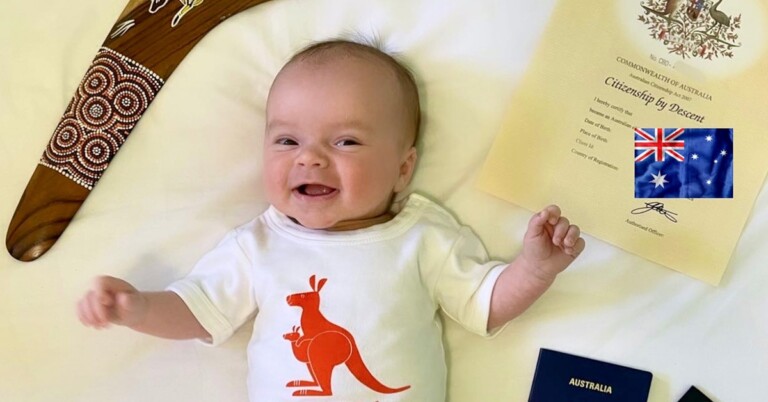
Furthermore, if at least one parent is an Australian citizen, your US-born baby is eligible for Australian citizenship by descent. This is its own significant process. A few things to know up front:
- The US-born baby is automatically a US citizen. That’s the 14th Amendment — born on US soil, US citizen. They’ll have a US birth certificate and a US passport eligibility from day one.
- Australian citizenship is NOT automatic. You have to formally apply via Form 118 through ImmiAccount. The fee is AUD $370 for the first child as of 2026. Processing takes 5-7 months.
- There’s a critical travel-timing trap. Once your baby is granted Australian citizenship, they legally have to enter and exit Australia on an Australian passport. But getting the Australian passport takes another 6 weeks AFTER the citizenship is granted. If you book travel to Australia in that gap, you can run into trouble. The simple rule: don’t apply for CBD until after any planned Australia travel in the next 6-9 months, OR plan to wait for both the citizenship grant and the Australian passport before traveling.
- US tax obligations for dual citizens are real and lifelong. As a US citizen, your child will have US tax filing obligations on worldwide income for the rest of their life — even if they never live in the US again. This kicks in once they earn above filing thresholds and is worth understanding before they’re old enough to care.
For the full Australian citizenship by descent process, I’ve written the complete 2026 guide here — it walks through Form 118, Form 1195, the Australian passport application, and the timing trap in detail.
For broader context on raising US-Australian kids, my piece on parenting in the US is here.
The mistakes Australians make when having a baby in America
After watching friends go through it and doing it twice myself, here are the most common patterns:
- Assuming the Australian system applies — turning up at the nearest hospital, expecting Medicare-equivalent coverage, or thinking the bill won’t be that bad. None of that is true here.
- Not confirming in-network status for the hospital, OB/GYN, anesthesiologist, AND pediatrician. The out-of-network surprise bill is a real and common disaster.
- Buying an international insurance plan too late — after pregnancy is already confirmed — and discovering the 10-12 month maternity waiting period excludes the birth.
- Skipping the SSN-at-hospital option because they didn’t realize it was offered. This wastes months.
- Not adding the baby to insurance within the 30-day window.
- Booking Australia travel during the CBD-but-no-passport gap, then having to deal with emergency passport paperwork from overseas.
- Underestimating the postpartum administrative load. Maternity leave laws in the US are weak — many parents don’t get paid leave at all. Plan for the admin tail to compete with infant care.
- Forgetting to check whether their Australian insurance products (life, income protection) cover them while overseas — and discovering the gap when claiming.
If you address those eight upfront, you’ll avoid most of what trips Australian families up.
Having a baby in America: FAQs
A vaginal birth runs $30,000-$50,000 in 2026; a Cesarean runs $50,000-$80,000. NICU stays add $5,000-$50,000+ on top. Without insurance, this is what you actually pay. With insurance, the billed amount is similar but your out-of-pocket is usually $1,500-$8,000 depending on plan tier and complications.
No. Australia’s Reciprocal Health Care Agreements do not include the United States. Medicare provides zero coverage for any care received in the US, including pregnancy and birth. You need US-based insurance from the start of the pregnancy.
Most international plans (Cigna Global, GeoBlue, IMG, and similar) have a 10-12 month maternity waiting period from policy start before maternity benefits kick in. If you’re planning a pregnancy and want an international plan, sign up well before you start trying. Pregnancy alone is not a qualifying event for enrollment.
The default in the US is OB/GYN — most pregnancies are managed by an obstetrician at a hospital. Midwives are available but less common than in Australia, and are found at birth centers, some hospital midwife practices, and home-birth practices (legal status varies by state). Insurance coverage for midwifery care is generally narrower than for OB/GYN care.
No. Australian citizenship by descent is NOT automatic for US-born children of Australian parents. You have to formally apply via Form 118 through ImmiAccount, pay the AUD $370 fee, and wait 5-7 months for processing. Until then, your child is American only and travels to Australia on their US passport with an ETA.
The birth certificate registration (handled by the hospital), the Social Security number application (offered through the hospital registrar — take this option), and standard newborn screening consents. Most hospitals discharge you with a folder containing the paperwork submission copies. Within 30 days, add the baby to your health insurance plan.
If you apply through the hospital registrar at birth, you’ll usually have the SSN within 4-6 weeks. If you skip the hospital window and apply later directly with the Social Security Administration, expect 8-12+ weeks and an in-person visit to an SSA office. Take the hospital option — it’s much easier.
Standard US discharge is 48 hours after a vaginal birth and 72-96 hours after a Cesarean. Most postpartum rooms are private, and the baby stays in the room with you (‘rooming-in’) for the duration of the stay. Some hospitals will discharge sooner on request if mother and baby are doing well.
As a US citizen, your child has US tax filing obligations on worldwide income for life. This kicks in once their income crosses filing thresholds — relevant in their late teens once they start earning. The US is one of the few countries that taxes by citizenship rather than residency, so dual citizens carry this obligation even if they never live in the US again. Worth understanding well before they’re old enough to care.
Yes — until your baby is granted Australian citizenship, they can travel to Australia on their US passport with an ETA, the same as any other American visitor. The complication arises AFTER citizenship is granted: Australian citizens must enter and exit Australia on an Australian passport. The 6-week gap between citizenship grant and Australian passport issue creates a travel trap. If you have Australia travel planned in the next 6-9 months, hold off on applying for CBD until after.
Not confirming in-network status for ALL providers involved — hospital, OB/GYN, anesthesiologist, and the in-hospital pediatrician. A single out-of-network provider in an otherwise in-network birth can turn a $3,000 out-of-pocket bill into a $30,000 one. Get this confirmed in writing during pregnancy, not after.
Disclaimer: I’m not a doctor, midwife, or licensed insurance agent. This article reflects my family’s experience and general public information as of 2026. For decisions specific to your situation — medical care, insurance coverage, and the citizenship process — talk to qualified professionals. Hospital practices, insurance terms, and government fees change; verify current details directly before relying on them.
You might also like
 Related to: Australian Citizenship By DescentHow to Apply for Australian Citizenship by Descent for US-Born Kids in 2026
 Related to: Expat Health InsuranceHealth Insurance for Expats in America: A 2026 Hub Guide
 Related to: COVID-19 Healthcare CostsIs Coronavirus (COVID-19) hospital and medical care free?
 Related to: UK Travel RequirementsNew UK Rules for Dual Citizens: What Dual-British Passport Holders Need to Know Before February 25
 Related to: Social Security NumbersSocial Security for new arrivals in 2026
 Related to: Travel Insurance CoverageCan I use travel insurance instead of health insurance in 2026?