







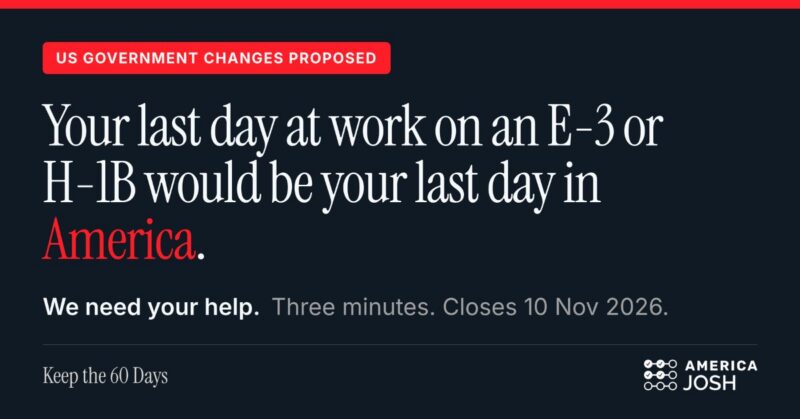


If you’re an Australian citizen and you want to live and work in the United States, the E-3 visa is almost certainly your best path. It’s faster, cheaper, and easier to renew than the H-1B, and it’s only available to us. This guide walks you through everything you need to know about the E-3 visa in 2026, including the major policy changes from September 2025 that have reshaped how the process works for new applicants and renewers alike.
If you want the live appointment data first, head straight to the E-3 Visa Appointment Calendar. For everyone else, let’s start at the beginning.
What is the E-3 visa?
The E-3 visa is a US work visa just for Australian citizens. It was created under the Australia-US Free Trade Agreement in 2005. It lets you live and work in the United States for up to two years in a “specialty occupation” role. You can also renew it indefinitely in two-year increments. There is an annual cap of 10,500 new E-3 visas. Historically the cap has never been hit, so allocation has not been a practical issue.
The E-3 is broadly similar to the H-1B visa, but with several major advantages for Australians. There is no lottery. The application is processed faster. Your spouse can work for any employer without separate sponsorship. The fees are dramatically lower. And it’s renewable without limit. So you can build a long-term life in the US on the E-3 if you want to.
We have a detailed comparison of the E-3 visa vs the H-1B if you want the full breakdown.


Who qualifies for an E-3 visa?
To qualify, you need to meet three criteria:
- Australian citizenship. Permanent residents do not qualify. You need to hold an Australian passport.
- At least a Bachelor’s degree in the field of work, or the equivalent in experience and training (roughly 12 years of progressive experience can substitute for a degree). See our guide on degree equivalency for US visas if you don’t have a formal Bachelor’s.
- A job offer in a specialty occupation that requires your degree and pays at least the prevailing wage for that role in that location.
What is a “specialty occupation”?
A specialty occupation is a role that requires:
- Theoretical and practical use of specialised knowledge
- A Bachelor’s degree or higher (or its equivalent) as a minimum entry requirement
There is no official list of qualifying roles. The test is whether the position itself requires a degree, not whether you happen to have one. A useful starting point is the O*NET Online database. It tells you what percentage of workers in any given role hold a Bachelor’s or higher. If the answer is “most of them,” you’re likely in safe territory.
What is the “prevailing wage”?
The prevailing wage is the average salary for your specific role in your specific work location. It is defined by the US Department of Labor. Your employer has to confirm that you’ll be paid at or above this number. The DOL publishes the rate. So the LCA filing process is objective, not negotiable.
Watch: E-3 visa explained
For a walkthrough of the basics in video form, watch the explainer below.
What changed for E-3 holders in 2025 and 2026
A lot has changed, and the existing E-3 articles you’ll find elsewhere on the internet are mostly stale. Here are the four policy shifts that matter most.
Interview waivers ended (October 2025)
Until 2025, many E-3 renewers could skip the consulate interview. They could simply renew by mail. That program ended. As of October 1, 2025, every E-3 applicant must attend an in-person interview. This includes straightforward renewals from people who have held the visa for years.
Renewals now mean a trip back to Australia. And a chunk of time spent waiting for a consulate appointment slot. Plan for two to four weeks in Australia minimum, depending on which consulate you book.
Third-country processing is mostly gone (September 2025)
A separate State Department rule took effect on September 6, 2025. It tells US embassies and consulates to only accept visa applicants who are residents of the country where the consulate sits. The old strategy of flying to Barbados, Vancouver, Toronto, or London for a visa stamp is over.
There are narrow exceptions if you can prove legal residency in another country. But for most E-3 holders, the realistic answer is now simple: you renew in Australia, or you don’t renew. Reports of refusals in London started within days of the directive.
E-3 visa revocations have happened (2026)
In early 2026, the State Department began revoking some E-3 visas. Most cases were tied to LCA compliance issues or doubts about the specialty-occupation test. The numbers are small in absolute terms. But the political environment around US work visas has tightened. We have an Expert Q&A on E-3 visa revocations if this concerns you.
LCA processing is slower
DOL processing on Labor Condition Applications has been slower in 2026. Some files are taking three to four weeks instead of the usual two. We have written about why your E-3 LCA might be taking forever. It includes the most common employer filing error that secretly adds weeks to your timeline.
Australia is not affected by travel bans
For peace of mind: Proclamation 10998 took effect on January 1, 2026. It suspended visa issuance for nationals of 39 countries. Australia is not on that list. Australians face no country-specific restrictions under any current travel ban.
How to get an E-3 visa: a step-by-step guide
The full process usually takes eight to fourteen weeks once you have a job offer. That’s from “I want to move to America” to “I have a visa in my passport.” The timeline breaks down roughly like this:
- Finding a job: 3+ months
- Interviewing and negotiating an offer: 3 to 6 weeks
- LCA writing and DOL approval: 2 to 4 weeks
- DS-160, appointment booking, and document compiling: 2 to 8 weeks (depends on consulate)
- Visa interview: 10 minutes
- Passport return with approved E-3 visa: a few days to two weeks
1. Find a job
The honest answer is that it’s harder than it used to be. Networking matters more than any other single factor. You’ll find mixed opinions on whether you should apply from Australia or visit the US first. The right answer depends on your industry, experience level, and where you’re targeting. Two things to do: get your resume Americanised, and set up US-based contact details so you look easy to hire.
Cold online applications work less often than warm intros. If you have any connection at all in your target city or company, use it. Even a distant intro beats the strongest cover letter.
When you’re looking at potential employers, the E-3 Visa Employer Database is a good starting point. It lists every company that has filed an LCA for an Australian, with industry, location, and wage data.
2. Get a proper offer letter
Once you have a verbal offer, you need a written offer letter that does more than a normal job offer. For E-3 purposes it must state:
- The role is full-time and is a specialty occupation requiring your specific degree
- The salary being offered for your professional services
Ideally it also includes:
- A brief overview of the company and where your position sits
- A rundown of responsibilities and duties tied to your degree
- Any specialised tools or technologies the role uses
- An explanation of why you specifically are qualified, referencing your degree and experience
This is going to be longer than a typical offer letter. The cleanest way to handle it is to draft the supplementary content yourself. Base it on the standard letter your new employer has sent, and ask them to sign off on the expanded version. You can then carry two documents to the consulate. A short standard offer letter, and a longer one that directly satisfies the E-3 requirements.
3. File the LCA
The next step is your employer filing a Labor Condition Application (LCA, Form ETA 9035) with the US Department of Labor. The employer must be the one to file it. But you should understand what it contains, because errors here cause delays later.
We have a full guide to the LCA including a walkthrough of every section. Filing is the part of the process where having an immigration lawyer involved makes the biggest difference. The form is specific, technical, and not always intuitive.
Once the LCA is “Certified” by the DOL (usually two to four weeks in 2026), have your employer print and sign the form. They then send you the signed and certified document. You’ll need it for your interview.
4. Fill in the DS-160 and book your appointment
Next you fill out Form DS-160, the online nonimmigrant visa application. It’s long. Have your passport, any previous US visas, and a complete record of past US travel dates on hand. Work through it slowly. Double-check every entry, because mistakes here are difficult to fix later.
We have a full guide to filling in the DS-160 with screenshots and step-by-step walkthroughs.
Once your DS-160 is submitted, you book your consulate appointment. Since late 2025 this means Sydney, Melbourne, or Perth in almost all cases. Use the E-3 Visa Appointment Calendar to compare current availability across the three Australian consulates. Wait times can vary by weeks depending on which one you choose.
5. Attend your visa interview
You will receive specific booking instructions. They cover what to bring, what time to arrive, and what’s prohibited inside the consulate. Read this carefully and follow it exactly. Bring more documentation than you think you need.
Our full guide to the E-3 visa interview covers the eight things to remember on the day. It also covers what documents to take and how to handle the questions. We also have a separate guide on how to prove ties to Australia at your interview. This is the area where most applicants under-prepare.
The interview itself is usually short. Once you’re done and approved, you can track your application status at the official CEAC status tracker. Don’t book a tight return flight. Wait until the status reads “ready for pickup” or your passport is on its way back to you.
6. Check your visa carefully
When you receive your passport back, you’ll find a full-page visa stamp inside. Before you do anything else, check every detail:
- Is your name spelled correctly?
- Is the employer name spelled correctly?
- Are the validity dates right?
- Is your photo correct?
- Is every other field accurate?
If anything is wrong, contact the consulate immediately. Do not travel to the US on a visa with errors. Correcting these mistakes is almost impossible from inside the United States. Easy at the consulate where they were made.
If everything is right, you’re good to go. See our guide to what documents to bring when entering the US on an E-3 visa for what to pack in your carry-on.
Key things to remember when getting an E-3 visa
Three things matter more than anything else: research, clear communication, and hiring a professional. Research the appointment wait times and processing times carefully so you know what you’re walking into. Communicate frequently with your new employer so the paperwork gets filed quickly and correctly. And hire an immigration lawyer — the cost is small compared to a delayed visa.
The other thing I want to say: take care of yourself. This process can feel really overwhelming, so reach out to your friends and fellow Aussies for support and look after yourself throughout. Drink water. Exercise. Pet a dog. Once you get through this you’re starting a brand new job, which is all sorts of stressful in its own way. You don’t want to be totally worn out when you walk in on day one.
E-3 visa renewals in 2026
Renewals work differently than first-time applications, and the rules changed significantly in late 2025. Here’s what you need to know.
Extension vs. renewal: two different things
There are two ways to extend your time in the US on an E-3:
- Extension of status (I-129): your employer files this with USCIS while you remain inside the US. It extends your status for another two years but does not give you a new visa stamp.
- Visa renewal: Done at a US consulate in Australia. Gives you a new visa stamp valid for another two years.
The key difference matters when you travel. If you have a valid I-94 from an I-129 extension but an expired visa stamp, you can keep working in the US. But you cannot leave and re-enter without renewing your visa stamp at a consulate.
We have a longer explainer on the difference between extending an E-3 status (I-129) and renewing an E-3 visa if you need to choose between the two.
Premium processing for I-129
USCIS offers Premium Processing on the I-129. It guarantees a decision within 15 business days. As of March 1, 2026, the Premium Processing fee is $2,965. It’s expensive. But if your timing is tight, it’s the most reliable way to keep your status uninterrupted. See our piece on Premium Processing for E-3 I-129s for the full picture.
The 240-day rule
If you file your I-129 extension before your current status expires, you can keep working for up to 240 days while waiting for the decision. This applies even if your I-94 expires in the meantime. This safety net makes I-129 extensions less risky than they look.
Planning your renewal trip to Australia
With third-country processing effectively gone, every renewal now requires a trip home. Practical guidance for 2026:
- Plan for two to four weeks in Australia, minimum
- Start the process at least four to five months before your current visa expires
- Book your appointment as early as the consulate calendar allows
- Use the E-3 Visa Appointment Calendar to compare Sydney, Melbourne, and Perth availability before committing
Build buffer time. Things go wrong. A passport return that takes a couple of days longer than promised can blow up tight travel plans. And you cannot re-enter the US until your stamped passport is back in your hands.
Family members on an E-3 visa
One of the biggest advantages of the E-3 is what it offers your family. Your spouse and unmarried children under 21 can join you in the US on E-3D dependent visas. The rules for spouses are unusually generous.
- Spouses can work for any employer in the US without separate sponsorship. They are employment-authorised incident to status, which means no separate EAD card is needed
- Children can attend school at any level, public or private
- Dependents travel with you and apply at the same consulate, usually at the same appointment
Our full guide to E-3 dependents covers the documents you need and the application process. We also have a separate piece on E-3D children and Social Security Numbers. This is one of the most-asked questions on the entire site.
Changing jobs and losing jobs on an E-3
The E-3 is tied to a specific employer. Your visa status is therefore connected to your employment. A few key rules to know.
Changing employers
You can change to a new employer on an E-3 by either:
- Having your new employer file a fresh I-129 with USCIS (you can use Premium Processing)
- Or going back to Australia for a new visa stamp tied to the new employer
See our guide on transferring your E-3 visa to a new employer for timelines and a practical comparison. You can also travel internationally after an internal change of employer. But you should plan carefully around when your old visa stamp is still valid.
Losing your job
If your employment ends, you have a 60-day grace period. Use it to find a new job, change visa status, or leave the country. After 60 days, you fall out of status. Our piece on losing your job on an E-3 covers the 10-day rule and the 60-day grace period in detail.
Side hustles, remote work, and study on the E-3
These are the questions we get asked most often by people already on an E-3.
- Can you earn money on the side? Mostly no. The E-3 is tied to your sponsoring employer, so most secondary income is not permitted. See our piece on side jobs and extra money on the E-3 for the nuances.
- Can you volunteer? Yes, but with caveats. See our guide on volunteering on an E-3 visa.
- Can you study? Yes, part-time or full-time, as long as it doesn’t interfere with your primary job. See studying on an E-3.
- Can you work remotely? It depends on whether you’re the primary visa holder or a dependent. See our guide on working remotely as an E-3D or E-3S.
- Can you do a short-term contract job? Sometimes — see E-3 visa for short-term contract jobs for the criteria.
- Who pays for the visa fees? Mostly the employer, with some exceptions. See who pays for E-3 visa fees.
E-3 visa employer and salary data: what the numbers show
We maintain the E-3 Visa Employer Database. It digests every Labor Condition Application filed by an Australian employer-sponsor since 2021. Some highlights from the most recent data (through Q2 2025):
Top industries hiring on the E-3
- Custom Computer Programming Services
- Management Consulting Services
- Engineering Services
- Other Scientific and Technical Consulting Services
- Data Processing, Hosting, and Related Services
Most common job titles
- Software Engineer
- Project Manager
- Director
- Senior Manager
- Account Executive
What the salary data tells you
Most E-3 holders are paid at Wage Level 4 (the DOL’s top tier). Levels 2 and 3 follow close behind. Tech roles on the West Coast tend to sit at the upper end of the salary range. Finance roles consistently come in higher than the average across all industries.
The full searchable database is on the Employer Database page. It lets you filter by industry, state, or specific employer. That’s useful when you’re targeting companies that have already sponsored Aussies.
The E-3 Visa Appointment Calendar
Our most useful tool is the E-3 Visa Appointment Calendar. It’s a community-driven tracker of live appointment slots at the three Australian consulates (Sydney, Melbourne, and Perth) plus a few overseas locations.
It’s free. The Australian community itself powers it, reporting what they see when they log into the booking system. And it’s the only data source that gives you a current picture of how long you’ll wait for a slot at each consulate. If you’re planning a renewal trip back to Australia, check the calendar before you book your flights.
Recommended immigration lawyers
For most E-3 applicants, hiring an immigration lawyer is worth the cost. They save you time, reduce the chance of errors that delay your visa by weeks, and give you someone to call when something goes sideways. Three lawyers I trust personally and recommend:
- Doug Lightman at Lightman Immigration
- Tara Gray at Tara Gray Law
- Zjantelle Cammisa Markel at Cammisa Markel
All three have deep experience with E-3 visas. Each has worked with hundreds of Australians on the move.
More E-3 visa resources
Detailed guides on the parts of the process that need their own deep dive:
- How to fill in the Labor Condition Application (LCA)
- How to fill in the DS-160
- What documents to bring when entering the US on an E-3
- How to apply for an E-3 visa by mail (limited circumstances)
- Can you look for work in the US before you get an E-3?
- How to explain the E-3 visa to potential employers
- Can you change from an E-3 to a green card?
- Which passport to use for dual citizenship: Australian or US?
- Embassy and consulate reviews
For the most current news on E-3 policy changes, the Immigration section of the blog is updated regularly.
E-3 visa infographic
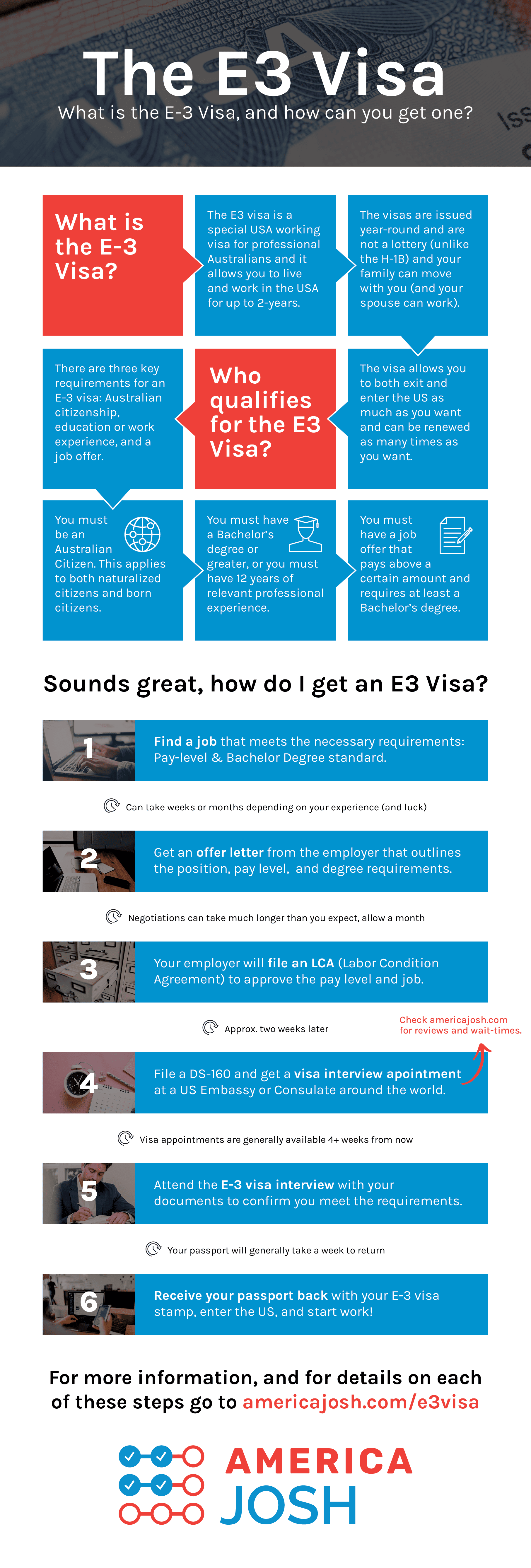
Click the infographic above to download the full PDF version.
E-3 visa FAQs
To qualify for an E-3 visa, you must be an Australian citizen, hold at least a Bachelor’s degree (or equivalent professional experience), and have a job offer from a US employer for a role that qualifies as a “specialty occupation” and pays at least the prevailing wage. Permanent residents of Australia do not qualify — only Australian passport holders are eligible.
The full process typically takes eight to fourteen weeks from job offer to visa in hand. This includes LCA filing (2 to 4 weeks), DS-160 completion and appointment booking (2 to 8 weeks depending on consulate), the interview itself (a few minutes), and passport return (a few days to two weeks). Timelines have lengthened in 2026 because interview waivers ended in October 2025.
In most cases no, not anymore. As of September 2025, US consulates have been directed to only accept visa applicants who are residents of the country where the consulate is located. The old practice of renewing E-3 visas in third countries like Barbados, London, or Vancouver has effectively ended for Aussies. Plan to renew in Sydney, Melbourne, or Perth.
Yes. E-3D spouses are employment-authorised incident to status, which means they can work for any US employer without applying for a separate work permit (EAD). This is one of the strongest advantages of the E-3 compared to most other US work visas. Children on E-3D status can attend school but cannot work.
Each E-3 visa is valid for up to two years, and you can renew it indefinitely in two-year increments. There is no maximum number of renewals. Many Australians have lived in the US continuously on E-3 visas for ten or more years. Note that the visa is tied to your specific employer, so you cannot simply stay if your job ends.
You have a 60-day grace period to find new employment, change to a different visa status, or leave the US. If you find a new employer within 60 days, they can file a new I-129 with USCIS to transfer your E-3 status. After 60 days without action, you fall out of status and must leave the country.
Generally no. The E-3 visa is tied to one specific sponsoring employer. If you want to work for two US employers, both must file separate LCAs and you would essentially hold two concurrent E-3 statuses. Secondary income from side hustles, freelance work, or unrelated employment is typically not permitted while on an E-3.
A visa renewal happens at a US consulate in Australia and gives you a new visa stamp in your passport. An I-129 extension is filed by your employer with USCIS while you remain inside the US and extends your status without giving you a new stamp. Extensions let you keep working but not travel internationally. Renewals are required to re-enter the US after travel.
As of March 1, 2026, Premium Processing for an I-129 (the form used for E-3 extensions and employer changes inside the US) costs $2,965. Premium Processing guarantees USCIS will decide your case within 15 business days, which is significantly faster than the standard processing timeline of two to four months.
No. Australia is not on any current US travel ban list. Presidential Proclamation 10998, effective January 1, 2026, suspended visa issuance for nationals of 39 countries, none of which is Australia. Australians applying for E-3 visas face no country-specific restrictions. The broader changes affecting E-3 visas are about interview procedures, not nationality bans.
No. E-3D dependent visas are only available to legal spouses and unmarried children under 21. Unmarried partners, de facto partners, and same-sex partners not legally married in a jurisdiction the US recognises do not qualify for E-3D status. If you’re in a long-term relationship and planning to move, the practical advice is to consider marriage before applying, or to look at separate visa options for your partner.
The prevailing wage is the average salary for a specific job in a specific US location, as published by the Department of Labor. Your E-3 employer must commit to paying you at or above this wage as part of the Labor Condition Application. If your offered salary is below the prevailing wage, the LCA will be rejected and the visa cannot proceed. The prevailing wage is non-negotiable and is based on objective DOL data.
This article is general information about the E-3 visa and is not legal advice. Immigration rules change, and individual circumstances vary widely. For specific questions about your situation, consult a licensed US immigration attorney.
You might also like
 Related to: E3 Visa TransferCan I transfer my E3 visa to a new employer – Timelines & Notice 2026?
 Related to: E-3 Visa InformationFrequently Asked Questions about E3 Visas
 Related to: E-3 Visa AppointmentsThe E-3 Visa Appointment Calendar: A Smarter Way to Track Appointments in Australia
 Related to: E3 Visa InterviewE3 Visa Interview – 8 things to remember in 2026
 Related to: Work Visa USAWork Visa USA – Types of Visas for Temporary EmploymentRelated to: Business and Tourism VisaB1/B2 Visa – Visas for Business & Visiting the United States in 2026



























Hi Josh,
Is it possible to be in the US with a tourist visa, look for work and then apply for E3 visa while still being in the US?
You could, in theory, change from a B1/B2 visa to an E3 while staying in the country, yes!
Thanks a lot Josh yes it is the DS-160 form. I thought that was correct I thought I seen that it expires after 30 days so obviously that is correct. Hopefully at some stage in the future I will have another job opportunity.
Thanks for the information great website and great information.
Hi Josh,
I have a quick question, I have completed my application for an E3 visa but I have not submitted it or made an appointment for the interview. Due to unseen circumstances the job is no longer available in the USA.. How does one go about canceling the online application? or do I just let it expire?
Hey Russell, do you mean the DS-160? You don’t have to do anything, just leave it.
Hi Josh,
Thank you for so much information.
My change of employer was denied. I cannot find any information that tells me how long until I have to leave the USA
Hi Alayna, was this a I129 that was denied? Was it a request for more information or something else?
Hi Josh, thanks so much for putting all this information together, it really is a fantastic resource!
I have a question: I had my E-3 status extended in April of this year without leaving the US, as I had intended on travel later in the year and flights back to Australia were expensive (and still are!). I want to visit home soon and I know I will need to obtain a new entry visa. My passport is also expiring next year and I was taking advantage of the trip home (and expedited processing) to renew my passport while I’m there. Do you know if the LCA used for my recent extension can still be used to renew the visa stamp? Does it matter that the LCA is associated with my old passport number?
Any advice would be really appreciated!
Hi Josh,
Does one need to be a homeowner (amongst other conditions) in Australia in order to qulify / be eligible to apply for E3 including the other criterion- Aussie National, degree, Job offer?
Not at all! You need to show “ties to Australia” but that can be things like family, connections, bank accounts etc.
Hi Josh,
Thanks for putting together this amazing resource which has been very helpful.
I believe I meet all eligibility requirements, however I am worried my Bachelor of Commerce degree at the University of Melbourne will not satisfy the bachelors degree requirement as this degree takes three years to complete. I am reading from other sources that the bachelors degree must be four years. Do you think my degree will be sufficient? Thanks.
So there’s a few trains of thought on this one: Some say that it’s not, and others say it really doesn’t matter. To be extra safe, the best thing you can do is get an equivalency done with an org like SilverGate Evaluations who will say “Yep your degree + experience = 4 years”.
Driver and cleaner and plumber
Hi Josh,
I am a fully registered psychologist in Australia. I am trying to find work here in California Mt Shasta specifically. People are interested in giving me an interview for behavioural health, mental health counsellor and psychologist position but are unsure how to proceed as potential employers are unclear what psychological registration I would hold in California from my Australian qualifications. Could you give me any feedback regarding equivalent registration to practice in California. Potentially what positions could I search for with the following qualifications;
I hold a bachelor in behavioural science, psychology major. A postgraduate in applied psychology and completed in 1996 my 2 years supervision hours to allow me to fully registered as a general psychologist with APHRA, ( Australia board of Psychology). I have 20 years experience.
Thank you for your feedback and any suggestions regarding Californian equivalence registration to provide professional counselling here in the USA. Regards Rita
Hi Josh,
I’m a PT based in Adelaide. I plan to move and work in NY. Do you know anyone who has gone same process in moving to NY using E3 visa that can help me? I just want to ask whether a Healthcare Worker Certificate is still needed to practice as a PT in NY. Thanks heaps. Cheers.